
Era Calculator
Earned run average (ERA) tells you how many earned runs a pitcher allows per nine innings. Enter earned runs and innings pitched — using baseball notation like 45.2 for 45⅔ innings — and the calculator gives ERA to two decimals, plus WHIP from walks and hits, and a softball option that uses seven innings.
- Free to use
- No sign-up
- Runs in your browser
ERA calculator
Pitching Stats Season Workbook
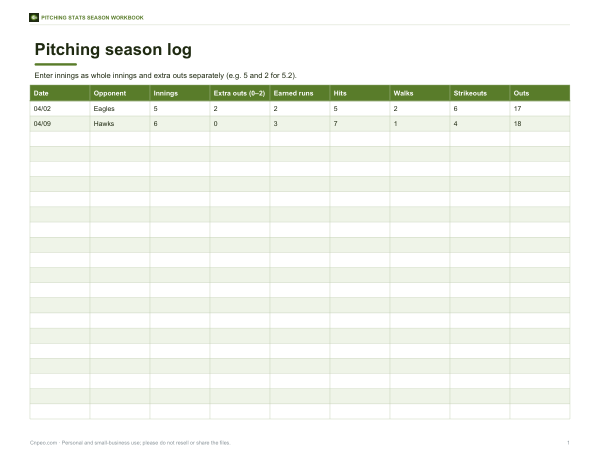
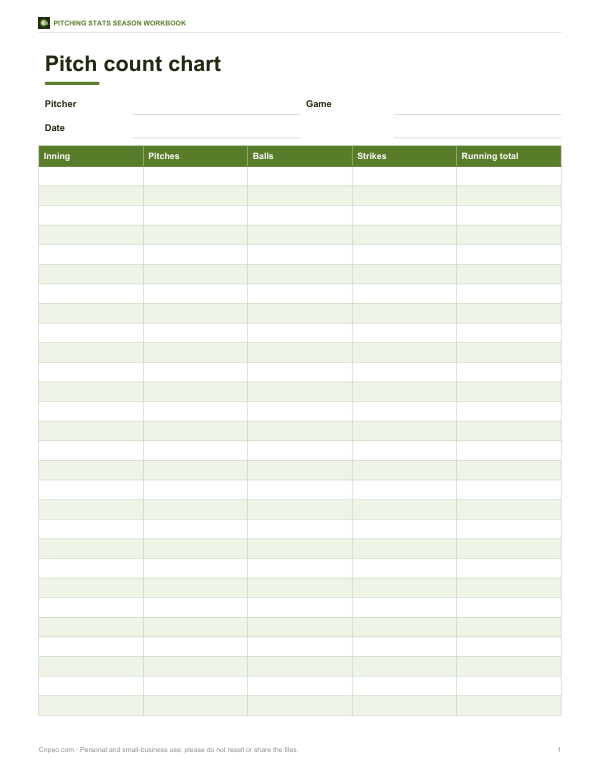
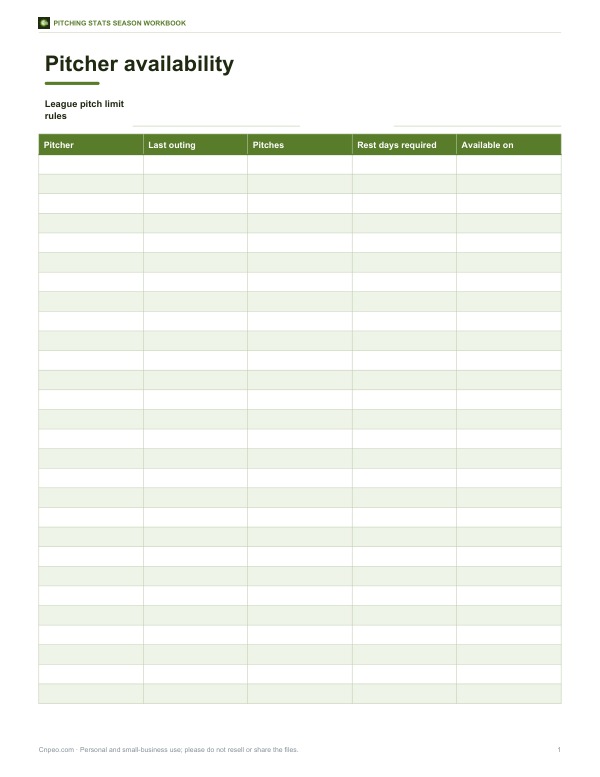
Excel pitching log that totals innings in thirds and calculates season ERA, WHIP and K/9, a printable pitch count chart, a bullpen availability sheet and a game scoring summary.
- Pitching log (XLSX)
- Pitch count chart (PDF, DOCX, XLSX)
- Bullpen availability (PDF, DOCX, XLSX)
- Stat formulas (PDF)
Formats: XLSX, PDF, DOCX. Instant download after payment (link valid 72 hours, up to 5 downloads). AI-assisted: the templates were drafted with AI help and reviewed and laid out before publishing.
$5.00 USD, one-time 4 files · about $1.25 each
- Instant download
- 7-day refund
- Secure checkout by Stripe
7-day money-back guarantee. Full refund within 7 days of purchase, even after you download.
Free sample: Bullpen Availability (PDF, 100 KB)
Full refund within 7 days — see the refund policy and license.
Free printables
Single sheets you can print right now, no sign-up. The full pack adds every sheet in one download plus the editable files.
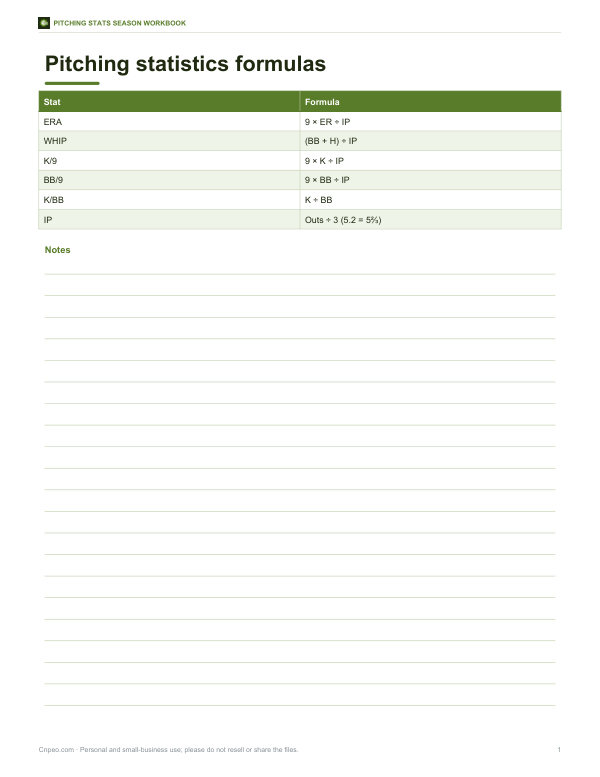 Printable Pitching Stats Formula Chart
The ERA formula
ERA = 9 × earned runs ÷ innings pitched. It expresses how many earned runs a pitcher would allow over a full nine-inning game at their current rate. A pitcher who allows 18 earned runs in 45⅔ innings has an ERA of 9 × 18 ÷ 45.667 = 3.55. In softball and many youth leagues, games are seven innings, so ERA is calculated with 7 instead of 9; some youth leagues use 6.
Handling partial innings
Innings pitched are recorded in thirds, one for each out, but written with a special notation: 45.1 means 45⅓ innings (one out into the 46th) and 45.2 means 45⅔. It does not mean 45.1 or 45.2 in decimal terms. Before dividing, convert: 45.2 = 45 + 2/3 = 45.667. Using 45.2 directly would understate the innings and give the wrong ERA. The calculator converts automatically and rejects impossible values such as 45.5.
What counts as an earned run?
An earned run is any run that scores without the help of a fielding error or a passed ball — the runs the pitcher is held responsible for. The official scorer reconstructs the inning without the errors to decide which runs would have scored anyway. Unearned runs still count on the scoreboard but not in ERA. That is why a pitcher can give up five runs in an inning and be charged with only two earned runs.
What is a good ERA?
In Major League Baseball, league-average ERA has typically been around 4.00 in recent seasons, though it changes with eras and rule changes. An ERA under about 3.00 is generally considered excellent, 3.00–4.00 good, 4.00–5.00 around average to below average, and above 5.00 poor. In high school, college, softball and youth baseball, the scale is different, so compare pitchers within the same league and level.
WHIP: walks and hits per inning
WHIP measures how many baserunners a pitcher allows per inning through walks and hits: (walks + hits) ÷ innings pitched. It is less affected by defence and luck with runners than ERA, and is a quick indicator of control. A WHIP around 1.00 is outstanding; around 1.30 is typical in professional baseball. The calculator shows WHIP when you enter walks and hits.
Worked example
A high school pitcher has thrown 45⅔ innings (recorded as 45.2), allowed 18 earned runs, 40 hits and 14 walks. Converting innings: 45 + 2/3 = 45.667. ERA = 9 × 18 ÷ 45.667 = 3.55. WHIP = (14 + 40) ÷ 45.667 = 1.18. In a seven-inning league, the same numbers give an ERA of 7 × 18 ÷ 45.667 = 2.76.
Limits of ERA
- ERA depends partly on the fielders behind the pitcher and the ballpark.
- Relief pitchers’ ERAs can swing wildly over small numbers of innings.
- Runners left on base by a pitcher who is then relieved are charged to the original pitcher if they score.
- Advanced statistics such as FIP (fielding independent pitching) try to isolate the pitcher’s own contribution using strikeouts, walks and home runs.
ERA for relievers and small samples
Relief pitchers often throw only one inning at a time, so a single bad outing can move their ERA dramatically. A reliever who allows three earned runs in one inning has an ERA of 27.00 for that game; over 20 innings in a season, the same outing adds 1.35 to the season ERA. When judging relievers, look at the number of innings behind the ERA and at other measures such as WHIP, strikeouts and inherited runners who scored.
Earned runs and scoring decisions
Official scorers make judgment calls that affect ERA, such as whether a misplayed ball was an error or a hit. In youth leagues the scorer might be a parent volunteer, so ERA can vary with scoring habits. If you track a pitcher across a season, use the same scorer’s judgments consistently and note any doubtful calls. Online scoring apps help by prompting the scorer through each play.
Tracking a season
Coaches and parents often track ERA through a season. Record earned runs and innings (in thirds) after each outing, then recalculate from the season totals — not by averaging game ERAs, which gives the wrong answer when outings have different lengths. The paid workbook totals innings in thirds automatically and calculates season ERA and WHIP.
Privacy
The calculator runs in your browser; nothing is stored or uploaded.
Frequently asked questions
How do you calculate ERA?
Multiply earned runs by 9 and divide by innings pitched (converted to thirds).
What does 5.2 innings mean?
Five and two-thirds innings — 17 outs.
What is a good ERA in baseball?
In MLB, under about 3.00 is excellent and around 4.00 is roughly average; youth and amateur scales differ.
How is ERA calculated in softball?
With 7 instead of 9: ERA = 7 × ER ÷ IP.
What is WHIP?
Walks plus hits divided by innings pitched.
Do unearned runs count in ERA?
No, only earned runs.
What does 0.1 innings pitched mean?
One out recorded — a third of an inning.
Can ERA be infinite?
If a pitcher allows earned runs without recording an out, ERA is undefined (often shown as infinite) until they get an out.
Should I average game ERAs?
No. Add up earned runs and innings for the season and calculate once.
What ERA do youth leagues use?
Many use the number of innings in their regulation game, such as 6 or 7, instead of 9.
Is a lower ERA better?
Yes, fewer earned runs per game is better.